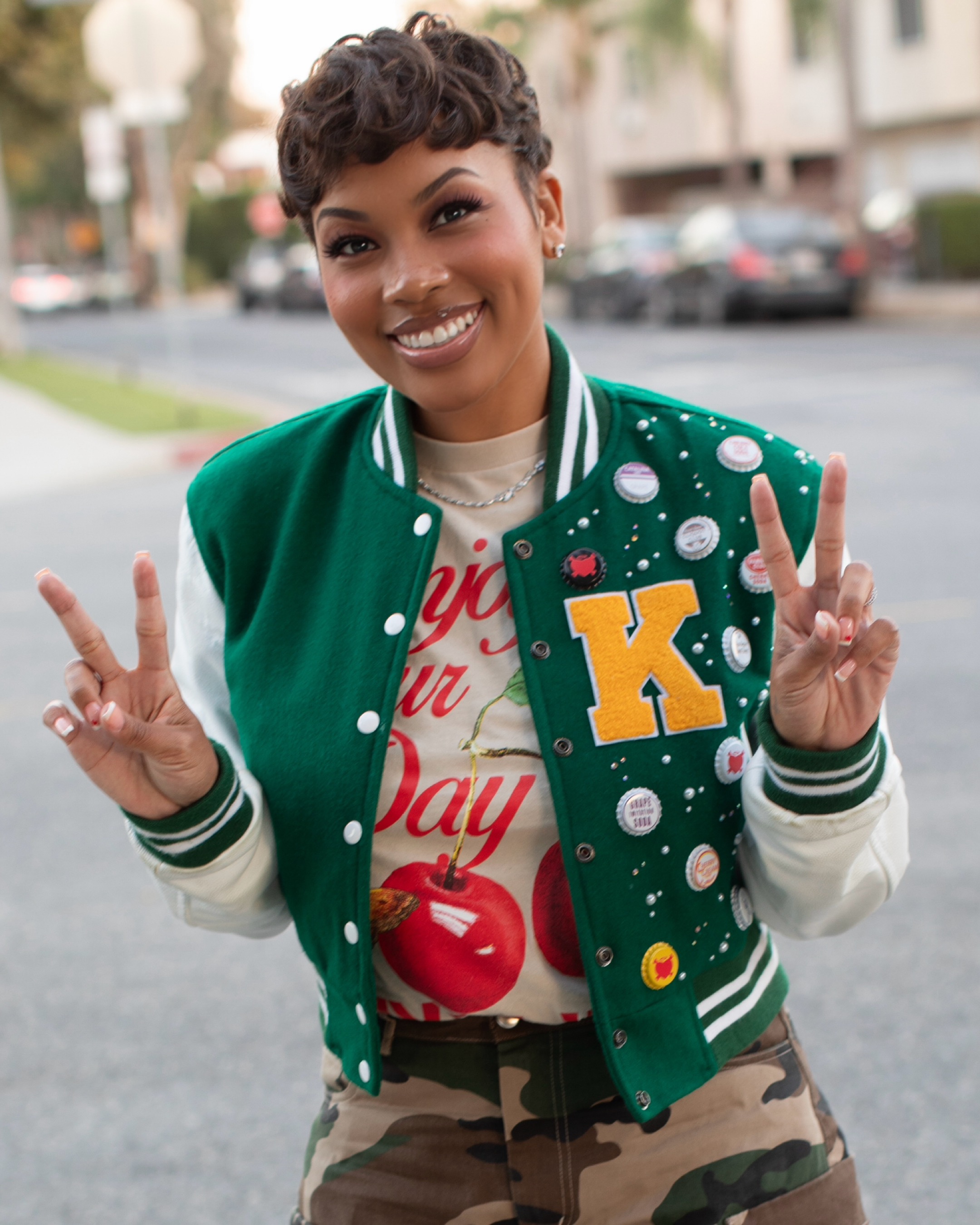
 Photo courtesy of Katty Customs Photo courtesy of Katty Customs
 Katty Customs did not plan this. The plan found her at eighteen, in a dream she almost did not tell anyone about. Now she is standing next to Steph Curry on national television.
Editor’s Note
Nicolle Knight did not arrive at sneaker culture through the usual channels. There was no apprenticeship. No industry cosign. No roadmap. What there was, instead, was a dream, a brother who believed her, and a faith deep enough to build a career on.
Hip Hop Weekly sat down with the creator, entrepreneur, and television personality known as Katty Customs to talk about origin, artistry, and the long distance between painting shoes in a Torrance studio and judging a sneaker competition alongside one of the greatest athletes alive.
This is the final story in our Women’s History Month series. We close the month the way we opened it: by documenting Black women who build worlds with their hands, their vision, and their refusal to wait for permission.
She was eighteen years old. Maybe nineteen. Somewhere between childhood and whatever comes next, in that hallway where most people lose their nerve.
The word arrived in a dream.
Not a business plan. Not a brand strategy. A single word, repeated, that she had never spoken before in her life. She woke up. Turned on the television. Saw a model on screen whose last name confirmed what she had just heard in her sleep.
She walked into the hallway and called her brother.
“What does Katty Lenoir sound like?”
He did not hesitate.
“That sounds like a dope clothing brand.”
She said bet.
That was 2007. The brand was called Katty Lenoir. Custom letterman jackets. Hoodies. Clothes made by hand for a market that did not yet exist.
The people closest to her were unimpressed. Starting a clothing brand in 2007, before Instagram, before direct-to-consumer culture, before “entrepreneur” became a personality type, was not something that earned applause.
It earned skepticism.
She kept going anyway.
There is a heart at the center of the Katty Customs logo. It represents Nicolle. Kind. Polite. The person everybody loves.
There are crossbones beneath it. They represent every person who told her she would be nothing. Every dismissal. Every silence where encouragement should have been.
And above it all, a halo. Not for vanity. For origin. A reminder that the name came from a dream, and she believes dreams come from God.
Every element of the logo is a response to something real. The kindness is hers. The defiance is earned. The faith is the foundation.
That is not branding. That is testimony.
Nicolle Knight grew up with two older brothers. The only girl.
Her brothers got the Jordans. She got the cute shoes. The ones that were appropriate for a girl. The ones nobody lined up for.
She started collecting sneakers at fourteen anyway. Not because someone told her she could. Because nobody told her she could not convincingly enough.
Years later, in high school, she had a pair of shoes she loved. Still fresh. No creases. But the soles had yellowed. She looked at them and thought the simplest, most dangerous thought a creative person can think.
I could fix that.
She painted them white.
And something opened.
There is a man named Mike Norice who had a store on Melrose. He was a sneaker artist. Nicolle worked there, originally to sell her custom clothing. But she watched him. She saw what he did to shoes. Faces. Portraits. Complex work.
She did not want to do what he did. She wanted colorways. Clean. Bold. Her own eye.
So she took a pair of her own sneakers and started.
She posted the work online. The reaction was immediate.
Orders came. Then more orders. Then she had to figure out pricing. Fifty dollars for a base custom. Ten dollars for each additional color. Three colors, seventy dollars. Four colors, eighty.
She will tell you plainly that she was not the best at it yet.
That did not matter.
She was building the muscle. Learning the craft in real time. Doing the creative equivalent of pressing demo tapes and handing them out at gas stations.
The breakthrough came with a pair of Adidas shell toes. She customized them for a client who brought them back and said, “These are crazy.” Then he brought every shoe he owned. Jordans. Nikes. Everything. He let her do whatever she wanted to them. Different colorways. Splatter art. Experiments.
When she posted those online, the response was no longer a trickle.
It was a flood.
Her fiancé at the time had a recording studio in Torrance. He was an engineer. The front space sat empty. Nobody was using it.
She asked for it.
She could not keep painting at home. The work was everywhere. On tables. On floors. On surfaces that were never meant to hold paint. The studio needed a studio.
He gave her the front. She moved in. A few months later, in the summer of 2017, she moved into her own suite.
She has been there ever since.
From that space, she began customizing sneakers for hip hop artists. For major companies. For people whose names she had only seen on screens. The work spoke for itself, and Instagram became her resume.
Every brand partnership she has ever secured came through that platform. Not through an agent. Not through a manager. Through the work, posted consistently, from a studio in Torrance that most of the world will never visit.
She does not say this as advice. She says it as autobiography.
The pipeline from a Torrance studio to a national sneaker design competition alongside Steph Curry took years. It also took a series of doors that only opened because she was already standing near them.
A man named Alan Maldonado had a show coming out on Netflix called Sneakerheads. Nicolle customized a pair of sneakers for him. Then she pitched him an idea. An exclusive shoe drop timed to the show’s release. Limited edition. See what happens.
It went well.
Maldonado started doing press for the show and mentioned her name to a company called Uproxx. They offered her a show of her own. She took it. She started customizing sneakers for celebrities on camera, building a portfolio that existed not just in a studio, but on a screen.
During that time, a man from the United Kingdom reached out. He had a brand called CANVVS, a sneaker company in London built around custom artists. He was developing a sneaker design competition. He wanted Nicolle to be a judge.
She said yes.
That was five years ago.
Five years of development. Five years of building the concept. Five years of waiting for the right moment and the right name.
Then, in August of last year, the call came.
“We got Steph Curry on board.”
Art of the Game premiered on the Rakuten and CANVVS networks. A national sneaker design competition. Steph Curry. Rakuten. CANVVS. And Katty Customs, the girl from Torrance who started with a fifty-dollar base price, standing on a stage she built her way onto one pair of shoes at a time.
Nicolle Knight has been in rooms where the person across from her decided what she was before she spoke.
A sneaker customizer. A woman in a male-dominated space. Someone smaller than the work suggests. Someone easier to underestimate than to take seriously.
She does not describe this as frustrating.
She describes it as motivating.
That shift, the one that happens when perception catches up to reality, is familiar to anyone who has ever been underestimated by a room they were overqualified to be in. It is the tax that Black women in creative industries pay at the door. The cost of walking into spaces that were not designed to expect them.
Nicolle does not dwell on it. She converts it. She lets the work change the room’s mind, and then she keeps working.
There is a question that reveals more than any career highlight.
What do the private conversations sound like? The ones between ambition and doubt. Between gratitude and hunger. Between a woman who has built something extraordinary and the silence that follows every room she leaves.
She is a workaholic by her own admission. Always creating. Always pushing to exceed what she has already exceeded.
But the faith is not decorative. It is structural. Every major turn in her career traces back to a belief that the dream at eighteen was not random. That the name was given, not chosen. That the path, no matter how nonlinear, was drawn before she walked it.
“I think the reason I was able to do all the things that I have done with my brand was because I followed God’s plan the best way I could.”
That is not a soundbite. That is a thesis.
Near the end of our conversation, I told Nicolle about my daughter. Six years old. The kind of child who asks a question and then sits perfectly still, waiting for the answer, as if the world depends on it.
I asked Nicolle what she would say to her.
The answer came without hesitation.
“Follow your dreams and stay consistent to true. Stay true to who you are. Never take a path of someone who is trying to tell you what to do with yours. If they are not where you want to be, do not listen.”
“God gives you dreams for a reason. He gives you thoughts for a reason. He gives you talents for a reason. He gives you ten talents. He only wants you to do one. And if you could do all ten, do it, because that is even better. But if you stay focused and true to who you are, nothing can stand in your way.”
Sneakers are where fashion, sports, and music converge. They are cultural artifacts. Status symbols. Canvases. Identities worn on the feet and understood at a glance.
Nicolle Knight did not enter that world through the front door. She entered through a dream, a hallway, and a brother who believed her before the world had any reason to.
From custom clothing in 2007, to a fifty-dollar sneaker operation built on trust and repetition, to a Torrance studio that became her launchpad, to Uproxx, to Netflix, to a five-year journey that ended with Steph Curry on national television.
That is not luck.
That is not timing.
That is a woman who heard her name in a dream and spent the next two decades making sure the world heard it too.
Not as noise. Not as trend.
As art. As enterprise. As proof that the nonlinear path is often the only honest one.
Katty Customs did not plan this.
She was called to it.
And she answered.