“There are bodies in the street and people getting paid leave and getting away with murder.” Colin Kaepernick said that in 2016, the first time anyone asked. He was right. It cost him his career and, by his own estimate, more than a hundred and fifty million dollars. Ten years later he is still paying for other people’s autopsies.
Let us start where the argument should have ended, because ten years of noise have buried it.
On August 26, 2016, asked why he would not stand, Colin Kaepernick said this:
"I am not going to stand up to show pride in a flag for a country that oppresses black people and people of color. To me, this is bigger than football and it would be selfish on my part to look the other way. There are bodies in the street and people getting paid leave and getting away with murder."
Bodies in the street. Paid leave. Getting away with murder.
He was not protesting the National Football League. He was not protesting the flag, the anthem, the country in the abstract, or anybody's grandfather who served. He was protesting police killing Black people and facing no consequence for it. He said so, in plain English, in the first sentence anyone asked him for.
He also sat before he knelt, and the story of how the kneeling started has been told wrong for ten years.
The version everybody repeats is that a former Green Beret named Nate Boyer talked him into it. Kaepernick put his own account on the record on September 14 of this year, with Tonya Mosley on NPR's Fresh Air, on the occasion of his memoir. It is not that.
Start with how anyone found out at all. He had been sitting for weeks and nobody noticed. Steve Wyche, a reporter for NFL Network, saw him on the bench during the anthem after the third preseason game and pulled him aside to ask why. That is the conversation that made it national.
It was Eric Reid. His own teammate, a safety on that 49ers roster, pulled him aside before the next preseason game. In Kaepernick's telling: "I agree with what you're doing. I want to be a part of it. And he was like, what if we go out and take a knee, we do it on the sideline and we do it right there with our teammates?"
The meeting with Boyer came after, and the 49ers arranged it. Kaepernick went because he was "open to perspectives." What happened in that room was not a suggestion being taken. It was a decision being shared. "We gave him the insight that we were going to go out and protest by taking a knee that night. He was like, oh, I think that's a great idea, but the idea came from Eric Reid."
There is one more part, and it explains a decade.
Boyer told them he would kneel with them. That is why he was on the sideline that night. Then, right before the anthem played, he came over and said he could not do it. He stood.
"I'll say disappointing to see him walk back like that, but it also gave us some insight as to what to expect moving forward and how people would take this as a moment that could be used opportunistically."
Two Black players decided to kneel. A white veteran who told them he would join and then did not has been credited with the idea ever since.
That is the record. Everything after it is what got built on top of the record to keep you from reading it.
There is a specific person behind the decision, and his name is Mario Woods.
On December 2, 2015, in the Bayview district of San Francisco, five officers opened fire on Woods. He was twenty six. The medical examiner counted twenty gunshot wounds, in his head, his back, his abdomen, his buttocks, his legs and his hands. Sixteen of those wounds ran back to front. Investigators recovered at least twenty seven shell casings on the street. It was captured on video by bystanders and the video went everywhere.
Kaepernick was the quarterback of the San Francisco 49ers when that happened in his team's city.
He has said since that Woods is the reason. He and his partner Nessa began building the Know Your Rights Camp in the period right after. Nine months later he sat down during an anthem.
So when people ask what he was protesting, the answer has a name, a date, an address, a video and an autopsy.
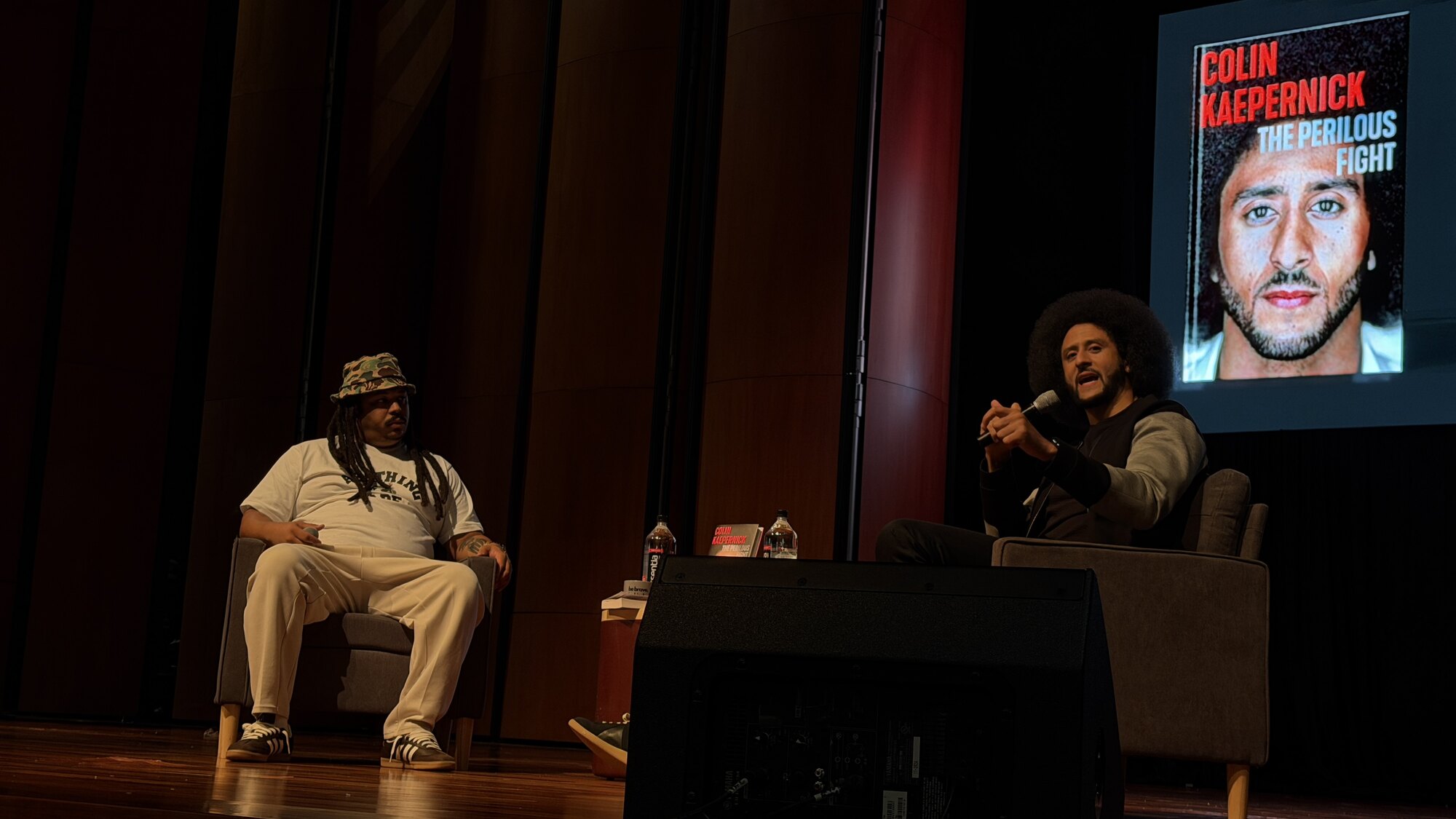
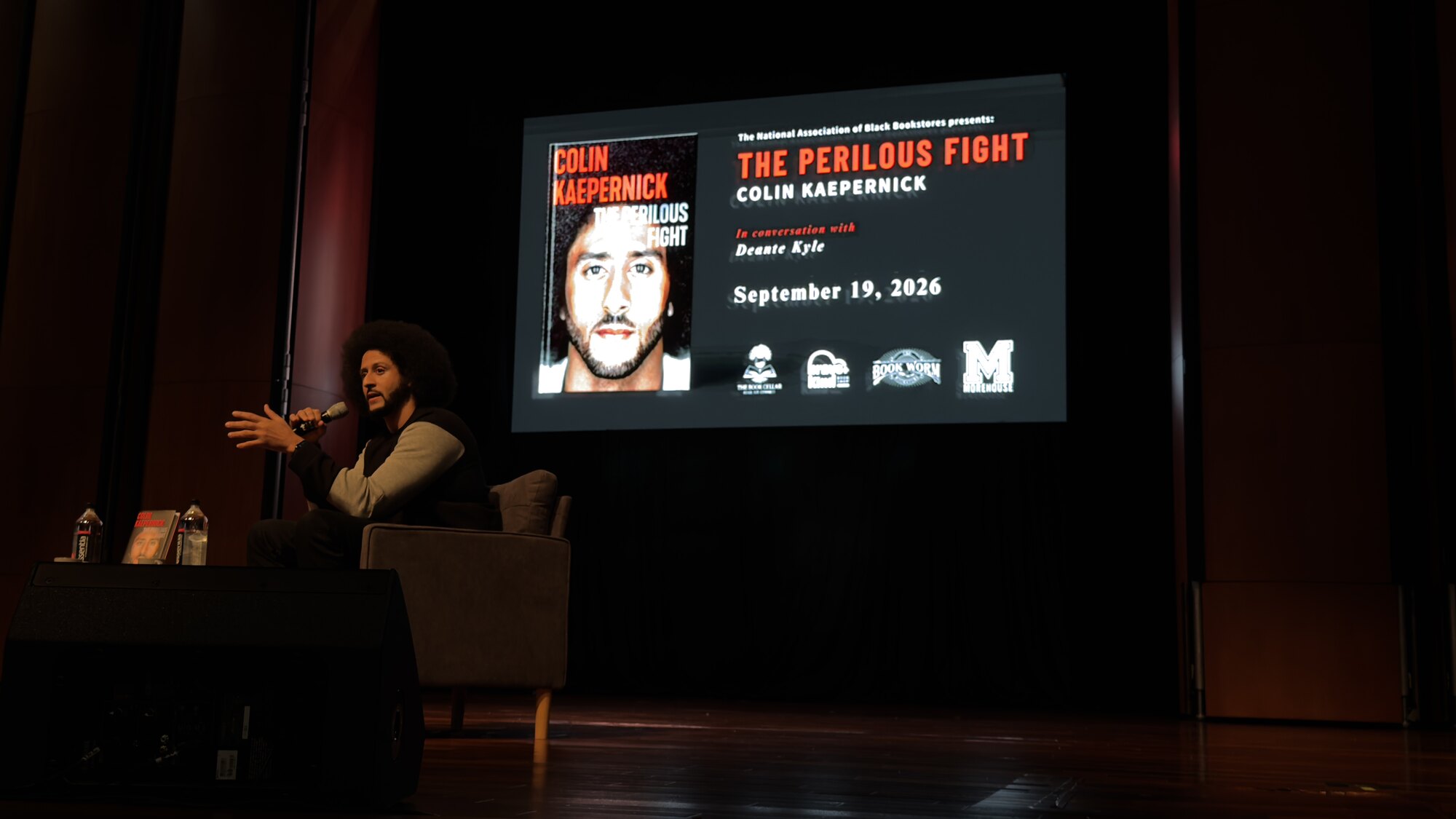
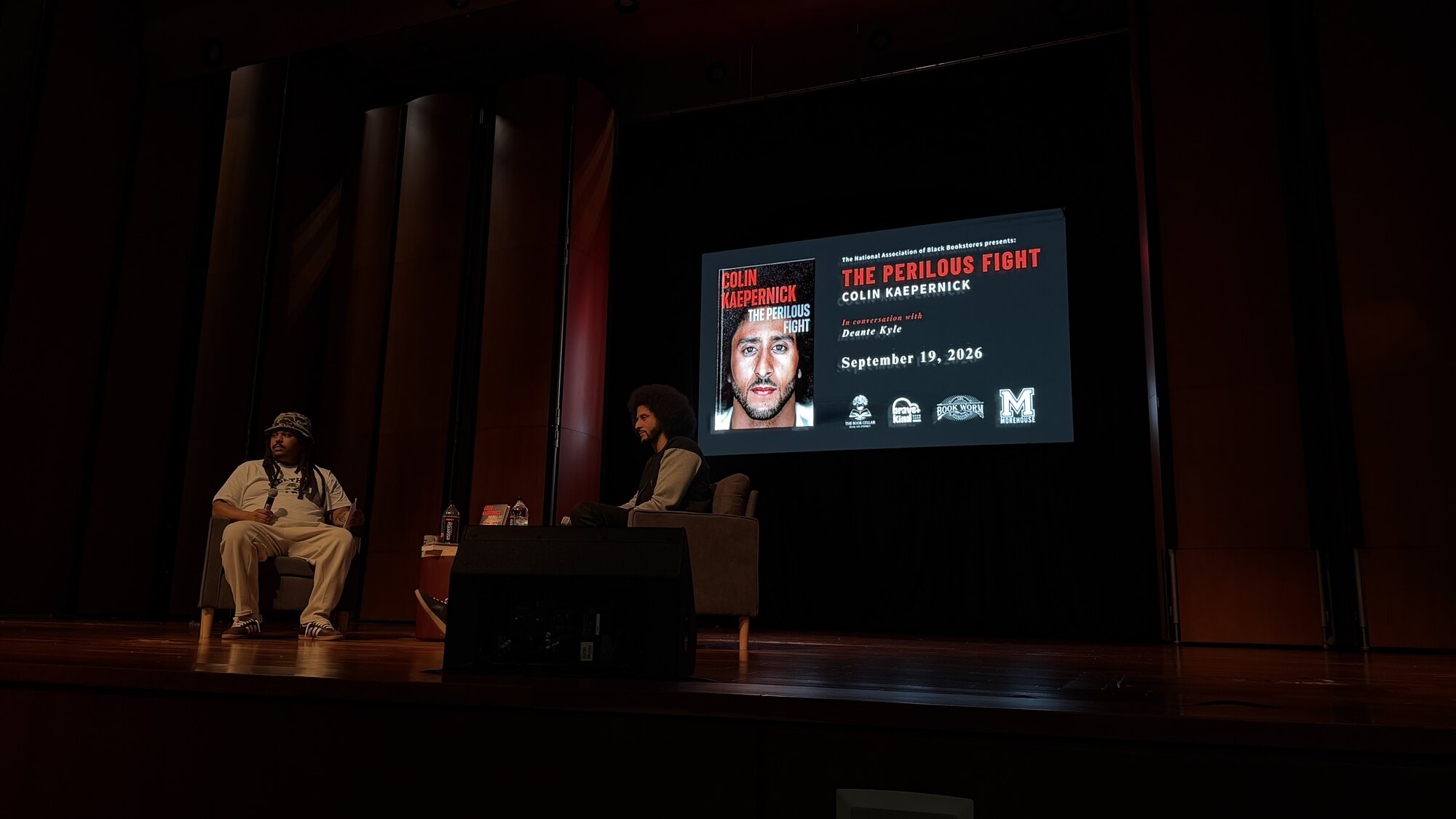
Saturday night at the Ray Charles Performing Arts Center at Morehouse College, Kaepernick sat with Deante Kyle in front of a full room. The occasion was The Perilous Fight, his memoir, published four days earlier by Legacy Lit. The night was presented by the National Association of Black Bookstores with three Atlanta stores, Brave + Kind Books, The Book Worm and The Book Cellar. Eleven cities, Black bookstores in all of them.
Ten years to the season since he first sat.
Asked near the end about the families, he did not reach for an abstraction. He listed people. Mario Woods. Freddie Gray. Alton Sterling. Philando Castile. Breonna Taylor.
Then: "We have to show up for each other. We have to fight for each other."
A decade of being told he was protesting a song, and the man is still reciting names.
The memoir starts long before the anthem, and the beginning explains more than the argument ever has.
He was born in Milwaukee in November 1987 to Heidi Russo, who was nineteen, white, and not in a position to raise him. At five weeks old he was adopted by Rick and Teresa Kaepernick, a white couple from Fond du Lac, Wisconsin, who had already buried two infant sons born with heart defects. The family moved to California when he was four. He grew up in Turlock, in the Central Valley.
A Black kid in a white family in a white town, and he has been clear that he understood the arrangement early. Kirkus, reviewing the book, described opening chapters that deal with racial abuse in childhood and the experience of being under a microscope every minute of every day.
That is the part people skip when they argue about a flag. Before he was a symbol he was a child learning, at close range and without a translator, that a room can love you and still not see you.
The book traces what he read on the way to the decision. Malcolm. Ali. Huey Newton. Angela Davis. Kirkus called it a bracing account of his battle for racial equality, which is a fair description of a man who was handed one country's story at home and went looking for the rest of it himself.
The thing that gets lost in the argument about 2016 is that this did not end in 2016.
Kaepernick's Know Your Rights Camp runs an autopsy initiative. When a Black family does not trust the official account of how their child died, it pays for an independent examination by someone with no relationship to the local authorities. This year it covered the second autopsy for Nolan Wells, a Mississippi teenager, with the body flown out of state so the work would be done by an examiner outside that jurisdiction.
Asked Saturday what moved him to pay for it, he answered about the parents.
"I look at [him] and see his parents and see his family. And the least we can do is give them clarity so they can try to [get] justice."
Then the part that explains the whole ten years: "We can't wait for it to knock on our door. We have to be proactive because we can't sit back and be reactive and wait for it to show up."
That is not a man rehabilitating an image. There is no image left to rehabilitate with the people who hate him, and the people who love him never needed it. That is somebody who believed a thing in 2015 and is still spending his own money on it in 2026 for families most of the country will never hear about.
He does not soften the number.
"I don't want to understate that I lost over $150 million. It's very real."
That is his estimate of the career he did not get to have, and he has said it in other rooms this month. A quarterback who reached a Super Bowl at twenty five played his last NFL snap at twenty nine.
He filed a grievance in 2017 alleging that owners had colluded to keep him out. Not that one team passed. That they acted together. He went outside his own union to do it: "I went out and found a separate law firm and separate lawyers outside of the NFLPA because of the lack of trust and confidence that I had in them." He says the NFLPA got interested only once the outside lawyers started winning in discovery and depositions, promised a plan inside twenty four hours, and that "that plan still has not arrived."
He also says he tried to avoid the whole thing. "We went to the NFL before ever filing, and said, look, we see what's happening. We need to sit down, discuss this, come to a resolution, because we both know this isn't right." What came back, in his telling, amounted to good luck.
The league has always denied that it blackballed him. It ended in February 2019 with a settlement, and the settlement was sealed. Both sides agreed to silence. One outlet later published a figure sourced to people briefed on the deal; no party confirmed it, no party denied it, both were bound, and other reporters argued publicly that it was too low to be true.
We are not printing that number, because nobody can stand behind it and the man it belongs to is not permitted to correct us if we get it wrong.
The amount was never the point. The point is that where a finding should be, there is a sealed envelope. No hearing. No ruling. Nothing in a record anyone can cite. The league bought silence, and the silence has bought seven years of people saying maybe nobody wanted him.
There is one more thing that happened this summer, and it did not come from a stadium owner.
On July 10, at Yankee Stadium, during the run celebrating thirty years of Reasonable Doubt, Jay-Z freestyled. He was answering criticism of his Target partnership, taken during a Black consumer boycott after the retailer walked back its diversity commitments. In the middle of it, he turned to Kaepernick.
"Buddy took a check, I ain't even mad at him, but along with that check you have to sign a non-disparagement. I'm the one they can't control."
Two things about that.
The first is that it appears not to be true. Sources with direct knowledge of the 2019 settlement have disputed that any non-disparagement clause existed. The confidentiality covered the terms of the deal, not Kaepernick's right to speak. The proof is public and has been for years: he has never stopped criticizing the NFL, including publicly counting the days since a team last signed a quarterback with his record. A man under a gag order does not keep a tally.
The second is worse, and it is the reason this belongs in a story about ten years of consequence.
The NFL sealed that settlement. That seal is what allowed seven years of maybe nobody wanted him. This summer it got picked up and used a second time, by somebody else, to suggest the man had taken a payoff and sold his mouth.
The silence the league bought keeps earning interest, and Kaepernick keeps paying it.
We covered that night in July, at length, in Marcy to the Mound. Six thousand words on three nights in the Bronx, including the freestyle, including this line, including the 2019 Roc Nation announcement and Nessa Diab's account of how the call to Colin actually went. That piece did not resolve the contradiction, because it could not. It held the celebration and the complication in the same room and said so.
What we did not have in July was Kaepernick's answer. We have it now.
Kaepernick has answered, on the record, repeatedly, and he answered the factual question directly.
He told Lester Holt on NBC that he never signed a non-disparagement agreement. Sources close to him have said the same since July: what he signed was a standard confidentiality agreement covering the financial terms. Nothing about his mouth.
Then he said what he thought the line was actually for.
"The backlash that he received for partnering with the NFL and going counter to people's interests in 2019 was a major problem for him, so much so that he's still bringing it up in 2026."
And: "People are now realizing, why are you so comfortable stepping into these positions that are counter to the positions that people on the ground actually want? And to me, I view that as speaking to a guilty conscience and trying to reposition or reframe the conversation."
At the Detroit stop on this book tour, he was drier about it.
"I was very surprised by it. Living rent free in there. At this point we are seven years post him doing that deal, and while you're doing your anniversary tour to celebrate your past work, that's the thing that's most top of mind for you? That's pretty remarkable at how bothered he is by that."
He also said he is not going to chase it. "I'm also not gonna respond to everything that's said about me, because I also believe the actions and the work that I do will speak for themselves."
Roc Nation declined to comment to NBC News.
Jay-Z's freestyle was defending a Target arrangement. An anniversary edition of Reasonable Doubt went through the retailer while Black shoppers were boycotting it over its retreat from diversity commitments. That is what he was answering when Kaepernick's name came up.
A spokesperson for Kaepernick told NBC News he would not be selling The Perilous Fight in Target stores.
He did not freestyle about it. He did not build a press cycle around it. A reporter asked and somebody answered in one sentence.
Then there is the tour, which is the louder decision.
Eleven cities. Brave + Kind, The Book Worm, The Book Cellar in Atlanta, and their counterparts in the other ten, organized through the National Association of Black Bookstores. That is why Saturday night happened in a theater at Morehouse instead of a chain with a folding table.
One man spent the summer explaining a retail decision from a stage. The other spent it routing his book through Black-owned stores and did not mention it once.
To NPR, he went further, because the book goes further.
He says Jay-Z informed him about the Roc Nation partnership with the NFL only after it had already been agreed, and that he told him so.
He says the timing was its own answer. The deal landed while he was still out of the league and while players were still kneeling.
He says the phone call was not really a phone call. "That's the only reason that he had called, to be able to say that he had spoken to me in that press conference."
He makes a harder allegation too, in his own words: that Roc Nation went "trying to go out and place hit pieces against me and say that I didn't want to play football anymore." Roc Nation has not responded to that claim.
None of that is comfortable and none of it should be. Jay-Z wore his jersey on Saturday Night Live in 2017 and dedicated "The Story of O.J." to him. That was real. So is what happened in 2019, and so is what got said from a stage in the Bronx in July.
Here is the part worth sitting with, and it is not about either man's character.
The NFL made an example of one player, and everybody learned what the example was for. Then it wrote a check and sealed the terms. Then the league hired a partner who could stand next to it and make the association survivable. Every step of that is the machine working exactly as designed, and it worked so well that the argument eventually moved off the owners entirely and became an argument between two Black men about who sold out.
That is not an accident. That is the product.
Near the end of Saturday night, talking about what it costs to take a position, he turned the arithmetic around.
"For every one of the owners that sit out there that wants to take an action against our community, they have to sit back and say, what's the risk if we try to do this? We often position it from they are always in a position of power and what can they inflict or impose upon us. I think we need to reframe that collectively and say no. They need to ask themselves, what do they have to lose?"
Five days before he asked it, Robert Kraft had answered a version of it.
On September 14, Macklemore was removed from the remaining American dates of Ed Sheeran's stadium tour, days after he said "Free Palestine" from the stage at MetLife.
Robert Kraft, who owns the New England Patriots and Gillette Stadium, confirmed on the record that he did not want him performing in his building. Kraft's stated reason was not the phrase itself. He cited "Macklemore's recent actions, material shared from the stage during Ed Sheeran's shows in New Jersey, and a broader history of antisemitic rhetoric and imagery," and said advocacy for Palestinians should not come at the expense of the Jewish community. Sheeran said the objection he was given concerned how part of the message was conveyed rather than everything in it. Macklemore says Sheeran told him Kraft had "rallied some of the other stadium owners and collectively they gave him an ultimatum," a claim Kraft has not addressed and no one has independently confirmed.
Set the disagreement aside and look at what nobody disputes. One owner decided who could stand on his stage and said so in writing. Sheeran spent a week on the phone with venues, one of them Kraft, and came away saying the decision was final and not his.
For nine years the word collusion was something Kaepernick had to prove and never got the chance to. It took a musician, a press statement and a week of phone calls for the shape of the thing to become legible to everybody at once.
Deante Kyle asked him what he would tell someone weighing how much to risk. Kaepernick took the question apart.
"Oftentimes we think about what is the cost. How much money did I lose? How is this going to affect my family? And there's a very real expense there."
Then he turned it over.
"But the flip side of that question is, what is the risk of us doing nothing? Does your father make it home? Does your brother or sister make it home? Does your mother make it home? Does your grandma or your son or your daughter make it home? And that is just a baseline entry level to this. We aren't even getting to addressing the broader system. We're just getting into, hey, don't kill us."
Hey, don't kill us.
That is the ask. That was always the ask. It has never been anything more elaborate than that, and a country spent ten years pretending it could not understand the sentence.
He was twenty eight years old, a Super Bowl quarterback in his prime, and he looked at a video of a man shot six times in the back in his own team's city and decided he could not keep his seat.
He gave away the first million dollars of his last NFL salary, a hundred thousand a month for ten months, while he was doing it.
He lost the rest. He estimates a hundred and fifty million. He has said publicly that he would do it again.
A decade later, with nothing left to gain and no league to win back, he is still paying for autopsies so that somebody else's mother can find out how her son actually died.
History has a bad habit with people like this. It waits until the argument is safely over, then puts the man on a postage stamp and pretends the country was always with him. It did that to King. It will try to do it here.
So let the record show it while it still costs something to say.
He was not protesting football. He was protesting the killing of Black people by police with no accountability, and he was right, and he said so in the plainest possible words the first time anyone asked, and this country punished him for the clarity more than the act.
He sacrificed a career and a fortune to say our lives matter. He is still saying it. He never stopped.
Remember him as courageous, because he was, and because the people who made him pay are counting on you to remember it differently.
For the culture.
Q Ward is the founding editorial lead of Hip Hop Weekly. The Bulletproof Class framework is developed in his forthcoming book, Proper Propaganda.
Photographs by Q Ward.
Quotations from Colin Kaepernick are from his September 19, 2026 conversation with Deante Kyle at Morehouse College's Ray Charles Performing Arts Center, attended by the author, except where otherwise attributed. Kaepernick's account of how the kneeling began is from his September 2026 interview with NPR. Additional reporting from NFL Network, NBC News, Paper, KRON4, the Detroit Metro Times, Kirkus, Booklist, Legacy Lit, Rolling Stone and Variety.