Three nights. Yankee Stadium. Attendance records set on Friday, broken on Saturday, and by the third night the crowd rushed the gates before the show could start.
That is the plain version of what happened between July 10 and July 12 in the Bronx. Jay-Z, thirty years into a run that began at D&D Studios and moved through every commercial and cultural summit hip hop has produced, invited New York to sit inside the discography with him. New York accepted. Then New York accepted again, harder. Then the third night New York tried to accept faster than the stadium was built to allow.
"Marcy to Madison Square" is a line Jay wrote for himself on The Black Album in 2003. It appears in the last verse of "Encore." He was making a geography then. This past weekend he was letting the geography make itself, on a field a subway ride from where he grew up, in a room that spent a century treating itself as civic architecture and had to spend three nights being treated as hip hop's home stage instead.
If you love this music, this was your weekend. If you have complicated feelings about the man carrying the weekend, those feelings did not have to wait outside. The room is big enough. That is the whole point of what happened.
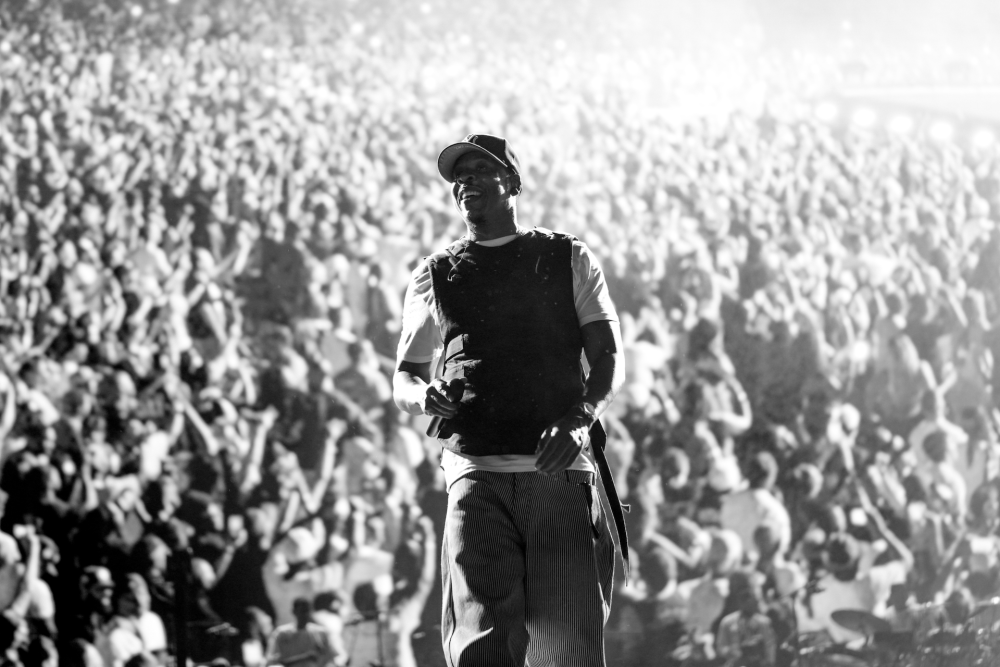
Night One. Reasonable Doubt at 30.
Forty-four thousand nine hundred and sixteen people showed up on Friday, July 10 for JAŸ-Z 30. That number was a Yankee Stadium concert record when it went up on the board. It held the record for one day.
The show opened with Beyoncé onstage. Not walking out later. Onstage from the first song. She joined Jay on "Can't Knock the Hustle," stepping into the part Mary J. Blige originated on the record. She was in a Yankees jersey. She stayed for "Money Ain't a Thing." She woke a stadium up with a piece of "Love On Top." She ended her run with a kiss.
Blue Ivy Carter is fourteen years old. She walked out during "Feelin' It" in a pinstriped Yankees jersey, sat down at a piano, and played the part. That is what she did in Yankee Stadium at fourteen, in the city she was born in, on her father's catalog. Consider what that says about the room the family has already built around her.
Nas walked out in Mets warm-up gear as "The World Is Yours" started. Read that sentence again. The two most cited rap voices New York ever produced, once cast against each other on wax, standing on the same stage running through "Dead Presidents," "The World Is Yours," "N.Y. State of Mind," and "Where I'm From," each rapper trading verses on the other's beats. That is not a nostalgia beat. That is the culture at rest with its own history.
Memphis Bleek walked out for "Coming of Age." Jay looked at him and said, "That's the definition of loyalty right there." Bleek has been in the frame since day one of Roc-A-Fella and has never left it. The line was earned before it was said.
Then JAZ-O appeared. Jay called him "directly responsible for me being on stage." JAZ-O was Jay's mentor in Marcy Houses in the 1980s, the man who first put a young Shawn Carter on records. He had not shared a stage of this size with Jay in decades. On the night the album that opened Jay's catalog turned thirty, the man who put Jay in the studio in the first place got the ovation. Marcy was honored on Marcy's night.
Alicia Keys closed with "Empire State of Mind."
Biggie appeared too, in the way Biggie has to appear now. His verse ran on "I Love the Dough." The room heard him. The room heard what it meant that he was not on the field to hear the ovation come back.
Jay's own line from the stage, quoted in Rolling Stone's next-morning review:
This album did 45,000 first week. Sold out Yankee Stadium. Culture. Always. Wins.
Reasonable Doubt came out on June 25, 1996. It debuted at number twenty-three on the Billboard 200 and moved slow because the industry did not know what to do with a rapper whose diction was tight and whose subject matter was hustler philosophy delivered with the cadence of a jazz standard. The label that carried it was Roc-A-Fella, built with Damon Dash and Kareem "Biggs" Burke from an office on John Street after the three of them were selling CDs out of a white Lexus. Thirty years to the month later, that album filled the biggest stadium in the biggest city in the country with the man who wrote it running it front to back.
One critic wrote that the only note against the night was that Foxy Brown never appeared for "Ain't No N***a." That is what the ledger looked like on the way out. A missing guest was the loudest complaint. The rest was the room admitting what the room came to admit. LeBron James watched from the floor. Jay put LeBron on the August 2005 XXL presidential cover, alongside Kanye West and Foxy Brown, with the Roc-A-Fella roster on the gatefold. Jay's own concept, Jay's cabinet, shot inside a mock Oval Office at Chelsea Piers. LeBron was not signed to any label. He was there as Roc La Familia. Twenty-one years later he was on the floor of Yankee Stadium watching the founder run the catalog three decades in. So did a rotation of peers who did not need to be on stage to be part of the thing.
Night Two. The Blueprint at 25.
Forty-five thousand eight hundred and thirty-two people showed up on Saturday, July 11 for JAŸ-Z 25. That number broke the record set the night before. The Yankees have hosted concerts for decades. This is what set the mark, twice in three days, both times for the same artist.
Slick Rick was the first guest. He walked out wearing a chain shaped like the continent of Africa and performed "La Di Da Di" and "Children's Story" after Jay opened the night with "The Ruler's Back." Read the sequence. Ruler's Back. La Di Da Di. Children's Story. Hip hop's foundational storyteller taking a Yankee Stadium field to run the two records that taught two generations of MCs how a story works. Jay opened his own anniversary night by handing the first spotlight to the man who wrote the manual.
Eminem walked out for "Renegade." The last time Jay and Em ran that record live together was 2010. Sixteen years is a long stretch to hold the wait. The performance rolled into "Lose Yourself" per the printed setlist. Whether Slim Shady is your top-five or not, the room read the moment the same way the room read Nas the night before. Two voices most people put in different weight classes, on the same field, running through the record that let one of them outrap the other on the other one's album.
Then Pharrell for the closing sweep. "Excuse Me Miss." "La-La-La (Excuse Me Again)." "I Just Wanna Love U." "Frontin'." "Allure." That is Pharrell running a Roc-A-Fella tour through the Neptunes end of the catalog, on the album whose 25th anniversary he was there to punctuate.
The moment that made it into every recap was "Heart of the City." Halfway through the song, the 4 train passed behind the stage. Real subway. Real Yankee Stadium platform. The song is what it is because it captures what the city sounds like from the inside. On Saturday night the city gave the song its own soundtrack in real time. Sometimes New York writes itself.
The Blueprint dropped on September 11, 2001. The album survived the day of its release. Then it defined the day of its release. That is what a canonical album does. The producers who built it were Kanye West and Just Blaze and Bink!, before Kanye was Kanye. Saturday night at Yankee Stadium was those beats played back for twenty-five years of context that did not exist when they were tracked.
Critics who wrote up night two came in more divided than night one. Some framed the record's twenty-five-year milestone as under-delivered against the opener's peak. Others called the guest run the best pound-for-pound stretch of the whole weekend. Both reads are honest. When a room has already climbed the mountain the first night, the second climb reads differently. That does not diminish the second night. It places it in relation to what the first night set.
Night Three. Extra Innings.
The third night was not on the original bill. When the first two nights sold out inside their first ticket window, Roc Nation added "JAŸ-Z Extra Innings" for Sunday, July 12. Ticketmaster carries it as its own event. That is how demand for this weekend actually ran.
The scheduled start was 8:00 PM. D-Nice opened with a thirty-minute DJ set at 8:00 PM. Then the night stopped being a concert for almost four hours.
A$AP Rocky was stuck outside. Charlamagne Tha God was stuck outside. Fabolous was stuck outside. Not the general admission crowd. The names sitting on the wrong side of a stadium wall that had never been asked to hold a room like this one.
According to NYPD sources cited by ABC7, a large group of fans rushed at least two of the stadium's gates, made it past security without being screened, and forced the venue into full lockdown. No one in or out. The gates reopened just before 10:00 PM with police at each entrance. Jay-Z took the stage at approximately 12:15 AM. Nearly four hours after the printed start. No injuries were reported. As of this writing, no official statement has been released by Roc Nation or the Yankees. NYPD has not published a count on how many fans made it in through the breached gates.
Jay walked to the microphone and said this:
I appreciate your patience. We gonna have a good time. I got some shit for you, I promise you.
That is a hall-of-fame delivery under conditions no headliner should have to hold. It is also the wrong story to make the show.
The story of the third night is that the container built to hold this weekend could not hold it. Not because Jay-Z drew too much demand. Because a three-night hip hop stadium stand of this weight is not what Yankee Stadium's security protocol was designed to protect against. The New York Yankees have hosted stadium concerts for decades. The gates never got rushed on those nights. The gates got rushed on Jay-Z's night. That is a signal about where hip hop's stadium moment sits right now, and it is worth naming as such. It is not a mark against Jay for pulling the crowd in the first place. It is a note to whoever builds the next stadium run for the next canonical rapper who earns it. Plan for demand that behaves this way. Because it will.
When he finally took the stage after midnight, he ran the catalog the way a man who has been doing this three decades runs a show. And he did not do it alone.
The-Dream came out. Rihanna came out. Swizz Beatz came out. Jermaine Dupri came out. Teyana Taylor came out. Fat Joe came out. Jadakiss came out. Jeezy moved a date of his active tour residency to be there. Usher did the same, coming off his own current run.
Then CLIPSE. Pusha T and Malice, on the Yankee Stadium field in the year of their return. Pharrell walked out with them, second Pharrell appearance of the weekend after Night 2. That is Star Trak stepping into a Roc-A-Fella anniversary, on the closer of hip hop's biggest weekend in years, with two decades of production history compressed into one sequence.
Then Beyoncé, back for the second time in a weekend. She opened Friday with him on "Can't Knock the Hustle." She closed Sunday standing next to the same man on the same field. Between those two beats, forty-eight hours and two Yankee Stadium concert attendance records broken by the same headliner. Not many artists have a spouse who can hold the anchor of the first night and the anchor of the third night without either appearance canceling the other one out. This weekend the number was one.
Extra Innings was the branding. What actually happened was the closer of the weekend turning a delayed finale into the show that gave up the most, with a roll call of peers who moved their own touring calendars to stand next to Jay when Jay was closing a chapter. Under conditions Jay did not build and could not have wanted.
The line.
From Marcy to Madison Square. To the only thing that matters in just a matter of years.
Jay-Z wrote that on The Black Album in 2003, in the last verse of "Encore." He put it on the album he sold as his retirement record. Seven years later he named his memoir Decoded and mapped the whole book onto the geography that verse laid down. Marcy Houses to Madison Square Garden. Bedford-Stuyvesant to Midtown. Public housing to the stage where the country's most-storied arena still puts its championship banners. That is the argument he decided his career was going to make on his own terms, out loud, in his own voice.
The critics have been using the same geography to argue the opposite for almost as long as he has been making it.
dream hampton was there in 1998, before hip hop and America agreed the Marcy-to-Manhattan line was even a summit worth marking. She wrote about the Roc-A-Fella crew as "kamikaze capitalists who just happened to be teenagers." That framing has stood up for almost thirty years, because dream was inside the culture that produced Jay, standing next to the moment as it was happening, using the vocabulary the moment invited. She did not have to wait for the man to make it in order to see what was under the argument.
Cornel West said this about Jay's stake in the Brooklyn Nets: "Jay-Z came from Marcy Projects. Look at him now, he owns the whole stadium. No! He owns one-fifteenth of one percent of the stadium, let's get it right." West's read is direct and quotable and the number is the number. It is not a takedown. It is a caution against confusing minority equity with ownership, from a scholar whose whole life's work has been separating the appearance of Black power from its substance.
Neither of them is being small. Both are inside the tradition of the culture keeping its own accounting. Jay-Z is enormous enough to survive that accounting. The accounting is enormous enough to matter.
What we hold at the same time.
If we are going to tell this story, we tell it. Not with justifications. With the ledger open.
The Range Rover moment. A generation of hustlers can quote the line about the four-oh and the four-six. It lives at the end of "Imaginary Player" on In My Lifetime, Vol. 1, released November 4, 1997, as a spoken outro to a track that is itself a thesis about who is real and who is playing pretend. A pretender pulls up. "You pull up in your 4.0 with your bitch. I pull up in the 4.6 with my bitch, with the seat back." Then the question. Then Jay's answer: "About thirty to forty grand, cocksucker. Beat it." Jay reused the same exchange in the 1998 short film Streets Is Watching, which is why some listeners remember hearing it there. It was on the record first. Range Rover's P38 platform, the one the line refers to, ended in 2001 because the L322 replaced it. Land Rover did not kill the trim because Jay said the wrong number was for pretenders. But by the mid-two-thousands, when a young Black man pulled up to the block in a P38, the question of which V8 was under the hood was doing its own social sorting, because a rapper from Marcy told the culture the difference mattered. That is what cultural authority actually looks like. It moves the meaning of a car before it moves the manufacturer.
That authority did not stay abstract. It reshaped closets and it reshaped brands.
The button-up shift. On "What More Can I Say" from The Black Album, Jay wrote, "I don't wear jerseys, I'm thirty-plus. Give me a crisp pair of jeans, n***a, button-ups." Mitchell & Ness had built a $36 million business by 2003, up from $2.2 million in 1999, on hip hop putting throwback jerseys at the center of Black male style. Two years after Jay's line, their sales were $15 million. He did not tell the culture to stop. He told the culture what he was doing next. The culture followed. In 2022, a Jay-Z-led investor group bought Mitchell & Ness for $250 million. Read that sequence one more time. He lifted the company, dented the company, then bought the company. That is what full-cycle capitalism looks like from inside the culture that gets sold back to itself. Some people watch that arc and see mastery. Others watch it and see the argument dream hampton made in 1998 playing out one more time in slow motion. Both readings live inside the same set of facts.
The NFL and Kaepernick. On August 13, 2019, at a press conference in Manhattan, Jay-Z announced Roc Nation as the NFL's live music entertainment strategist and co-steward of Inspire Change. Six months earlier, in February 2019, Colin Kaepernick's collusion grievance against the NFL had settled. Terms confidential. Kaepernick was never in the room for the Roc Nation partnership discussions, according to public statements from his camp. Jay-Z, at the press conference, said, "I think we've moved past kneeling. I think it's time to go on to actionable items." Nessa Diab, Kaepernick's partner, said the following on Hot 97: "I do mind you wrapping it in social justice when you're working with an organization that denies someone an opportunity." That critique is fair. It is also the record. The record also includes who Roc Nation actually put on the halftime stage across the deal's run. Shakira and Jennifer Lopez. The Weeknd. Dr. Dre, Snoop Dogg, Eminem, Mary J. Blige, Kendrick Lamar, 50 Cent, and Anderson .Paak. Rihanna. Usher. Kendrick Lamar solo. Bad Bunny. The stage got Blacker and browner year over year. The man behind kneeling never got his job back. Both are on the record. That is what "actionable items" bought and did not buy.
Friday night at Yankee Stadium, Jay-Z made the choice to bring Kaepernick's name back to the surface. The third song of his opening set was a freestyle, labeled by Consequence as the JAY-Z30 Freestyle. The bars, verified across EssentiallySports, HotNewHipHop, BlackAmericaWeb, Bossip, Cassius Life, and EURweb: "They running outta characters, had to bring back up Kaep again. Buddy took a check, I ain't even mad at him. But along with that check you have to sign a non-disparagement. I'm the one they can't control." Two things sit on the same bar. The specific factual claim inside the line is contested at the receipts level. TMZ Sports reported the next day, citing sources with direct knowledge of the 2019 settlement, that no non-disparagement clause exists in the deal, and cited Kaepernick's own continued public criticism of the NFL over the six years since as the evidence. Kap does not have a job. He also has not been quiet. Beyond the receipts is the harder question. Kap was blackballed for kneeling. Jay took the deal after Kap was blackballed. Jay stayed inside the deal for the seven years since. In 2026, in front of ninety thousand people, Jay chose to make Kap the punchline in a freestyle about being accused of selling out. The person who took the check is calling the person who could not get another check embarrassing. That is on the record too.
Nessa Diab, Kaepernick's wife, has spoken to the deal in her own words, on her own feed. Her account: Jay never spoke to Colin before cutting the NFL arrangement, only after, and the conversation ended in a bad place. She said she heard it herself. She has also said Jay's team worked behind the scenes to discredit Colin to the press. On the Atlanta workout the league staged in November 2019, she said Colin declined because the NFL's waiver would have surrendered his future employment rights, cameras were denied, and public access was denied. That is Colin's wife naming the mechanics from the inside. The receipt cited most often against the non-disparagement bar is Kaepernick's own November 2020 post counting one thousand three hundred sixty-three days of being denied employment. A man silenced by contract does not run a public counter of his own blackballing.
Target, June 2026. The sharpest current example, because it lives inside this week. On June 26, 2026, less than three weeks before Yankee Stadium, Jay-Z released a Target-exclusive white-vinyl double LP of Reasonable Doubt for the album's thirtieth anniversary. Target has been the subject of an active Black-led boycott since February 2025 over the retailer's DEI rollback. The album that built Jay-Z's independence myth, sold on his terms in 1996, put on shelves for its thirtieth anniversary at a retailer a coalition of Black consumers has been asking Black artists not to feed. That is the tension in real time, not in retrospect. This weekend's Yankee Stadium celebration and the Target-exclusive vinyl are the same news cycle.
Jay addressed the boycott critique directly on Night One, inside the same JAY-Z30 Freestyle. The opening bars, verified across Yahoo, The Grio, Complex, AllHipHop, AOL, and Consequence: "They say I sold out. Yeah, I did sell out. Three nights. I sold Yankee Stadium the hell out." Then, on the retailer point: "You shopping at Amazon, or you boycotting? You posting on Instagram, that's Meta, boy. Stop it. You know Google owns YouTube. You picking and choosing and politicking, as usual." Read those bars carefully. The "sold out" turn is a clever pun and a rhetorical dodge. The critique of selling out was about corporate alignment during an active boycott. It was not about ticket velocity. The Amazon and Meta and Google frame is the harder move. It sits on top of a real point, which is that no American consumer lives inside a purity structure in a country this consolidated. It also collapses two things that are not the same thing. A working-class Black person shopping for groceries or diapers or toothpaste at the retailer they can reach is not performing the same civic act as a multi-billionaire signing an exclusive brand deal with that retailer during the boycott's active period. Consumer purchases are constrained by necessity, geography, monopoly, and price. Corporate partnerships are strategic elections made from a position of maximum leverage. Boycott is a tool of the constrained. Brand deals are a choice of the powerful. When a billionaire deploys "your hands are dirty too" against the people using the only pressure they have, he is inverting who holds power in the exchange. That inversion is the intellectual sleight of hand the freestyle asks the audience to accept as symmetry. It is not symmetry. It is the person with all the leverage arguing that people with almost none of it should stop asking him to use his differently.
The counterweight, because the piece is not a court proceeding. The Shawn Carter Foundation was founded in 2003 by Gloria Carter and her son. Twenty-three years in, it has deployed more than $25 million, supports roughly 145 students annually with up to $15,000 per student, and has moved multiple generations of Black students through postsecondary education whose families could not have paid the freight. The Reform Alliance launched on January 23, 2019 at John Jay College, co-founded with Meek Mill and Michael Rubin and others. The initial pledge was $50 million. The first legislative win was California AB 1950, signed in September 2020, which capped probation terms in the state and freed thousands of people from an incarceration system that runs on technical violations. The Made in America Festival has contributed close to $2.9 million to United Way of Greater Philadelphia and Southern New Jersey over its run. None of that washes the Target vinyl clean. None of the Target vinyl washes AB 1950 clean either. Both are on the same ledger, and that is the point. This weekend was celebrated across three nights not despite the ledger but with the ledger present in the room, with the first two nights alone drawing more than ninety thousand and each setting a new Yankee Stadium concert attendance record in turn.
And the moment the defense collapsed. On August 31, 2022, on a Twitter Spaces with Rob Markman, Jay-Z said, of being called a capitalist, "They start inventing words like, you know, 'capitalist,' things like that. We've been called n***** and monkeys and s***. Y'all gotta come up with stronger words." There is a version of that argument that stands. Capitalism is not the worst word ever used against a Black man in America. Fair. That was not the version Jay delivered. That version dismissed a structural critique by comparing its intensity to a slur, which is the same move the people who benefit from that structure make when they want the conversation to end. On that specific Twitter Spaces, the defense did not hold. It rarely holds when the defender is the same person the critique is aimed at. That is on the record too.
If you are keeping track: by every measure hip hop uses, Jay-Z is the unquestioned greatest of all time on a microphone. By every measure the American economy uses, he is an apex hyper-capitalist. Both sentences are the reporting, not the opinion. Every paragraph above lives inside both sentences at the same time, in the same person, at the same table, at the same weekend at Yankee Stadium. That is what it means for hip hop to have raised a subject enormous enough to hold a full American contradiction and stay on his feet under the weight of it. He is flawed. He is imperfect. He is also, by the sum of the record, the largest artist the genre has ever produced. All of it stands together or none of it stands honest.
The system, not just the man.
Everything named above is on Jay-Z's ledger. It is also on the ledger of the country that produced him.
Capitalism does not carry virtues the way jazz carries virtues. It does not have community inside it. It does not have restraint inside it. It does not have dignity inside it. It produces those things as byproducts when the operator chooses to spend on them, and it strips them just as easily when the operator does not. That is the difference between a system and a discipline. Jazz has a discipline. Capitalism has an accounting.
Every rapper in the Yankee Stadium building this weekend was born inside the American accounting. Every rapper on the field was raised in neighborhoods that accounting built. Marcy Houses was not a nature preserve. It was a public housing complex built in 1949 in a country that had already decided which zip codes would get infrastructure and which would get containment. The kid who came out of Marcy did not choose capitalism. Capitalism chose the terrain the kid was allowed to live on.
There is a version of the critique that says the answer is not to participate. Do not chase the money. Do not stack the ownership. Do not sit at the tables the system is running. That version is honest about the system and dishonest about the choice, because the choice most Black kids in this country face is not "capitalism or something else." It is "the version of capitalism that eats you, or the version that eats a little slower because you climbed high enough to sit closer to the kitchen."
Jay-Z climbed. He climbed until he was inside the kitchen. Then he bought the restaurant. Then he tried to keep the neighborhood the restaurant sat in from being flipped out from under itself. Sometimes he did that well. Sometimes he did it badly. Sometimes he did it in ways that helped the neighborhood and enriched him at the same time and made both facts uncomfortable to name at the same table. All of that is on the record. What is also on the record is that the system he climbed inside of never asked whether it would produce a man like him. The system just produced him. And now the culture has to reckon with what it means when the summit of Black economic achievement in an American life is still living inside the frame that made the climb necessary in the first place.
That is why this weekend at Yankee Stadium was celebrated by more than ninety thousand people across the first two record-setting nights alone, with a third sold-out finale on top of it, and it is also why the celebration will never be simple. Watching a Black man win the American game is not the same as watching him invent a new game. The American game does not have new rules for its Black winners. It just has the same rules and a different tax bracket.
You could tell me the answer is not to play. I would answer that the game started before you were born, and the field it is played on is the same one your grandmother had to walk across to get to work. There is no exit door from a system you were born inside. There is only the choice of what kind of player you become, and what you do with what the game returns to you when you take the piece the game agreed to hand back.
None of that erases what dream hampton said in 1998. None of that lets Jay off the Target hook, or the Kaepernick hook, or the Twitter Spaces hook. It holds those complications inside the larger complication, which is that no one who was born into the American accounting climbs out of it clean, and everyone who tries is asked to explain themselves in a vocabulary the accounting itself invented.
Jay-Z is the largest test case hip hop has ever produced for that question. Yankee Stadium was three nights of the culture watching the test case perform. The complications did not disappear. They stood in the room with the celebration, and they will stand in the room at every anniversary that comes after this one.
That is the whole point of holding an argument this big out loud. Not to resolve it. To keep the culture honest about what it is actually looking at when it looks at its greatest.
The archive is writing itself.
Hip hop rarely gets a stadium residency of its own. Eminem played Yankee Stadium in 2010. Jay and Kanye ran Watch the Throne there in 2011. A three-night solo stand honoring one man's discography, hosted inside the room the city treats as civic architecture, is a small list. Jay's three nights this weekend add a chapter the culture can cite when it argues for its own canon in rooms that still don't recognize the canon exists.
What Jay was doing on that field was not a nostalgia lap. Nostalgia laps look backward. Jay's chapter is a forward move. The JAY-Z 30 series has more dates still to run. London on September 4 at Tottenham Hotspur Stadium. Paris on September 10 at Stade de France. Los Angeles on October 23 at SoFi Stadium. The victory lap is global. The three-night New York stand was the archive being written where the archive was born.
The distinction matters. When a canonical artist celebrates a milestone by staging a definitive retrospective in the city that raised him, and then extends the retrospective to other capitals of the culture, he is not closing the book. He is amending it. The current culture gets to watch the archive grow while the archive is still active.
That is what makes this different from a Hall of Fame induction or a Kennedy Center Honor. Those are moments the culture holds for its subjects when the subjects can no longer hold themselves. JAY-Z 30 is the subject holding the moment while the culture watches. The catalog is the argument. The catalog is not finished making the argument.
Mr. Carter.
Multiple things are true at once. This weekend at Yankee Stadium solidified you as at least Mount Rushmore, and depending on who you ask, the greatest to ever do it on a microphone. That sentence stands unqualified. It does not need a footnote.
The other sentences do.
Being a Black American hyper-capitalist at your altitude means principles you built your name on, ideals you rapped into the culture, foundations of who Shawn Carter told the world he was, reach the points where they contradict how Shawn Carter now lives. The life you live is anti to the block you left. That is not an accusation. It is a description of what altitude does to origin in America. It is what the system requires of anyone who climbs high enough for the system to have to notice him. Some of the practices that built the empire are antithetical to the ideals that built the man. Both things live in the same person because the country asked them to.
But the block did not leave. Marcy is still there. The people who put you on are still there. They still shop at the retailers on the boycott list because rent does not care about the boycott. They still stream your catalog because you are still theirs. They still defend your name in the barbershop when the takedown pieces run, because they know what you came from and they know what it took. And they read pieces like this one and hold it next to their love for you, because their love for you is not conditional on you being simple. Their love was never conditional on that. It was conditional on you being real. This piece is us being real.
You can hold Mount Rushmore in one hand and the Target vinyl in the other. We are holding both in the same paragraph. We are asking you to hold both too.
For the culture.
When we say greatest of all time, we are naming an argument, not resolving one. When we say greatest to ever pick up a microphone, we are naming a category most of American culture still refuses to seat at the same table as literature and jazz and film.
Jay-Z was born in Marcy Houses on December 4, 1969. He wrote "Marcy to Madison Square" in 2003. Twenty-three years after that verse, Yankee Stadium held his three-night stand. That is the line drawn from beginning to now. It runs through every complication in this piece and it does not stop being the line because of the complications. That is why the complications are worth naming. Small subjects don't get an argument this long. This one does because the subject is that big.
The line is his. Marcy is the origin. Madison Square was the destination Jay wrote for himself in 2003. Yankee Stadium was the new destination he added this weekend, on his own terms, in his own city. The map keeps drawing itself.
Marcy to the mound.
For the culture.