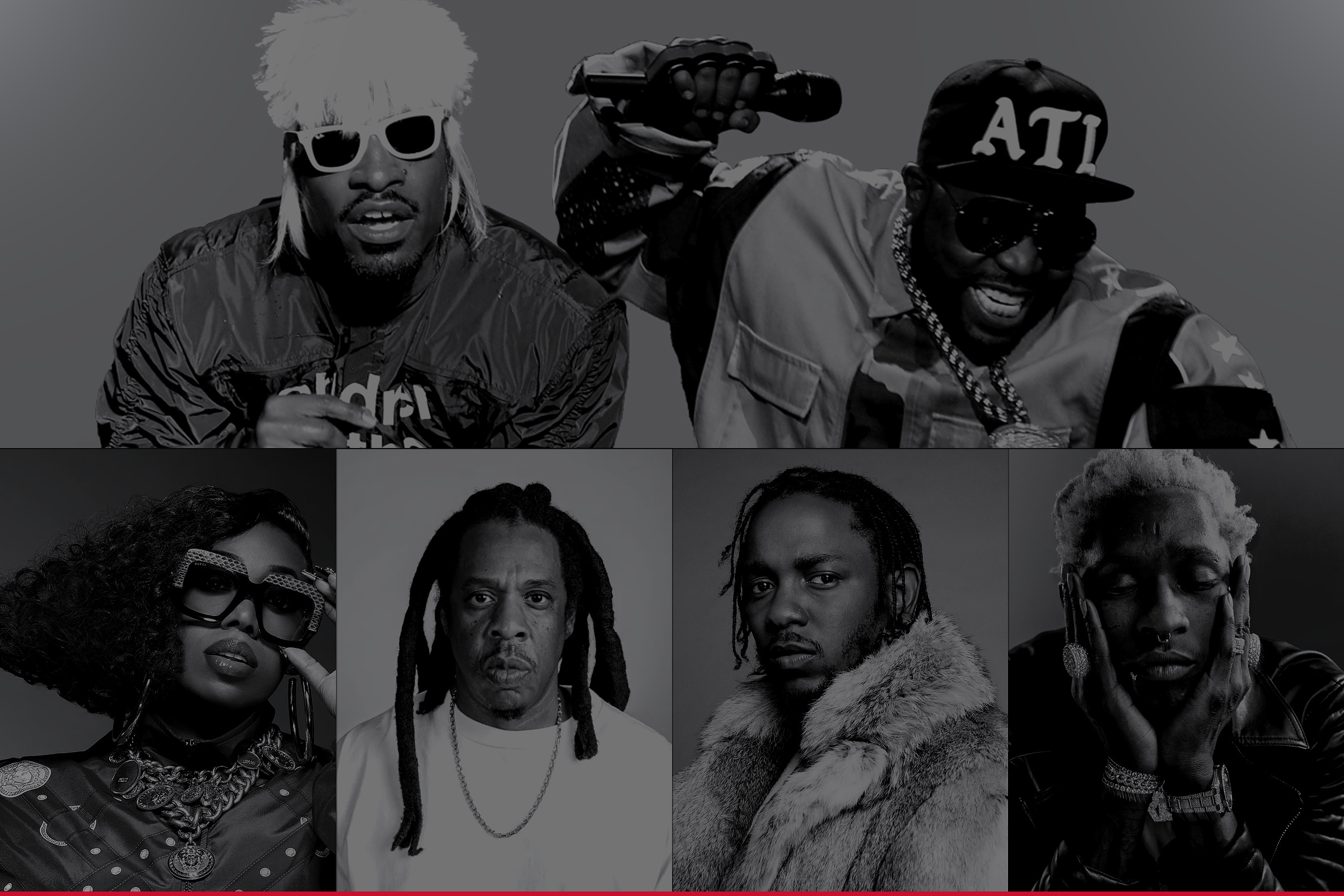
 Composite by Hip Hop Weekly Composite by Hip Hop Weekly
 Kendrick Lamar, Jay-Z, Missy Elliott, Young Thug and OutKast made the cut. The list, the curators, the names that didn't make it, and what gets admitted when the New York Times calls rap songwriting.
The New York Times dropped its list of the 30 Greatest Living American Songwriters on April 27, 2026. Hip hop got five seats at the table.
Kendrick Lamar. Jay-Z. Missy Elliott. Young Thug. OutKast.
The full list runs across five decades of American song, from Bob Dylan and Smokey Robinson to Bad Bunny and Lana Del Rey, with stops at Stevie Wonder, Dolly Parton, Carole King, Paul Simon, Mariah Carey, Babyface, Taylor Swift, Bruce Springsteen, Lionel Richie, Fiona Apple, Willie Nelson, Nile Rodgers, Valerie Simpson, The-Dream, Brandy Clark, and Lucinda Williams along the way.
But the headline is the hip hop count. Five names. One sixth of the list. And depending on how you read Bad Bunny's place in the genre conversation, you can argue six.
That number does not feel revolutionary in 2026. It is.
For most of the modern songwriting canon's history, "songwriter" meant Tin Pan Alley, the Brill Building, the Nashville room. The lyric tradition that hip hop comes from, the verse-and-cadence architecture of the rap song, has been argued about, dismissed, and re-litigated in critical spaces for fifty years. The New York Times putting Kendrick, Hov, Missy, Thug and OutKast on the same page as Bob Dylan is not just a list. It is a definition.
Jay-Z. The Times described his work as "intricate configurations" of dense wordplay with layered meaning. Twenty-something years of catalog. The bar for what rap as literature can hold up to.
Kendrick Lamar. The Pulitzer pulled the door open. The catalog kept it open. The Times credited him with blending pop, rock, soul, funk and quiet storm into rap's frame, treating him as a genre-builder, not a genre-citizen.
Missy Elliott. The first woman in hip hop in the Songwriters Hall of Fame, in 2019. The list confirmed what every producer and writer in the room already knew.
Young Thug. The Times called him a "poststructural dissenter" reshaping what a song can sound like. The flow as instrument. The voice as paint.
OutKast. The duo entry. And here is the move we want to make first, because the critical world has been lazy with this for thirty years.
The OutKast seat names Andre 3000 and Big Boi. The press almost always orders them in that order, and almost always lets the conversation drift to Andre alone within ninety seconds. We are flipping that today. Big Boi is half of the genius. Not Andre's counterpart. Not Andre's foundation. A co-architect from Atlanta whose pen built the funk floor that ATLiens, Aquemini, Stankonia and Speakerboxxx stand on. He wrote the verses that taught a generation of Southern rappers what cadence could do. Bombs Over Baghdad lives in the speed of his pen. Rosa Parks turns on his anchor. SpottieOttieDopaliscious is a duet of equals where Big's verse holds the room.
And here is what we want to be clear about. The New York Times got the call right. Putting OutKast in the slot was the only honest way to recognize this catalog. There is no solo Andre 3000 hip hop album. Speakerboxxx and The Love Below were two discs of one OutKast project, not two solo records. The Andre and Big Boi songwriting canon, the catalog that earned this seat, is OutKast.
Recognizing them as a duo is not a compromise. It is the recognition. A solo Andre slot without Big Boi would have been a lie. A solo Big Boi slot without Andre would have been an even bigger lie. OutKast is the truth. We celebrate that the Times got both of them through the door together.
Lists are only as honest as the people making them. The Times sent ballots to roughly 250 musicians, critics, historians, DJs and industry executives, then handed the final cut to six in-house critics: Wesley Morris, Jon Caramanica, Joe Coscarelli, Lindsay Zoladz, Jody Rosen, and Danyel Smith.
Danyel Smith is the name to circle. The longtime Vibe editor. The host of Black Girl Songbook. The author of "Shine Bright." A Black woman with a forty-year ear for the music and the receipts to back it up. Hip hop's five seats on this list are not an accident. They reflect who was in the room when the list got drawn.
A list is a fight, and a list this loud invites a fight back. Hip hop fans flagged the absence of Lauryn Hill, Nas, Eminem, J. Cole, Drake, Lil Wayne, Pharrell, and Q-Tip.
Lauryn Hill is the conversation that will not sit down. The Miseducation of Lauryn Hill is on every "greatest album of all time" list any honest critic has built in the last twenty five years. The fact that she did not make a list of 30 living American songwriters is the kind of omission that becomes its own essay.
Nas. Eminem. The catalogs speak.
The point is not to invalidate the five who got in. The point is that hip hop's bench is so deep that even a generous list comes up short.
For HHW readers, the story isn't who got named. The story is what got admitted.
The New York Times, with a curatorial team led in part by one of the most respected Black women in music criticism, just put hip hop on the same page as Stevie Wonder, Bob Dylan, Carole King and Paul Simon. The list calls them songwriters. Same word. Same standard. Same shelf.
That has been the argument since "Rapper's Delight." It has been the fight since Run-DMC met Aerosmith. It has been the work since Rakim wrote a sixteen that broke the ceiling on what a verse could do.
Five names doesn't settle the question of hip hop's place in American songwriting. It just confirms the question cannot be ignored anymore.
The next list is going to have more.