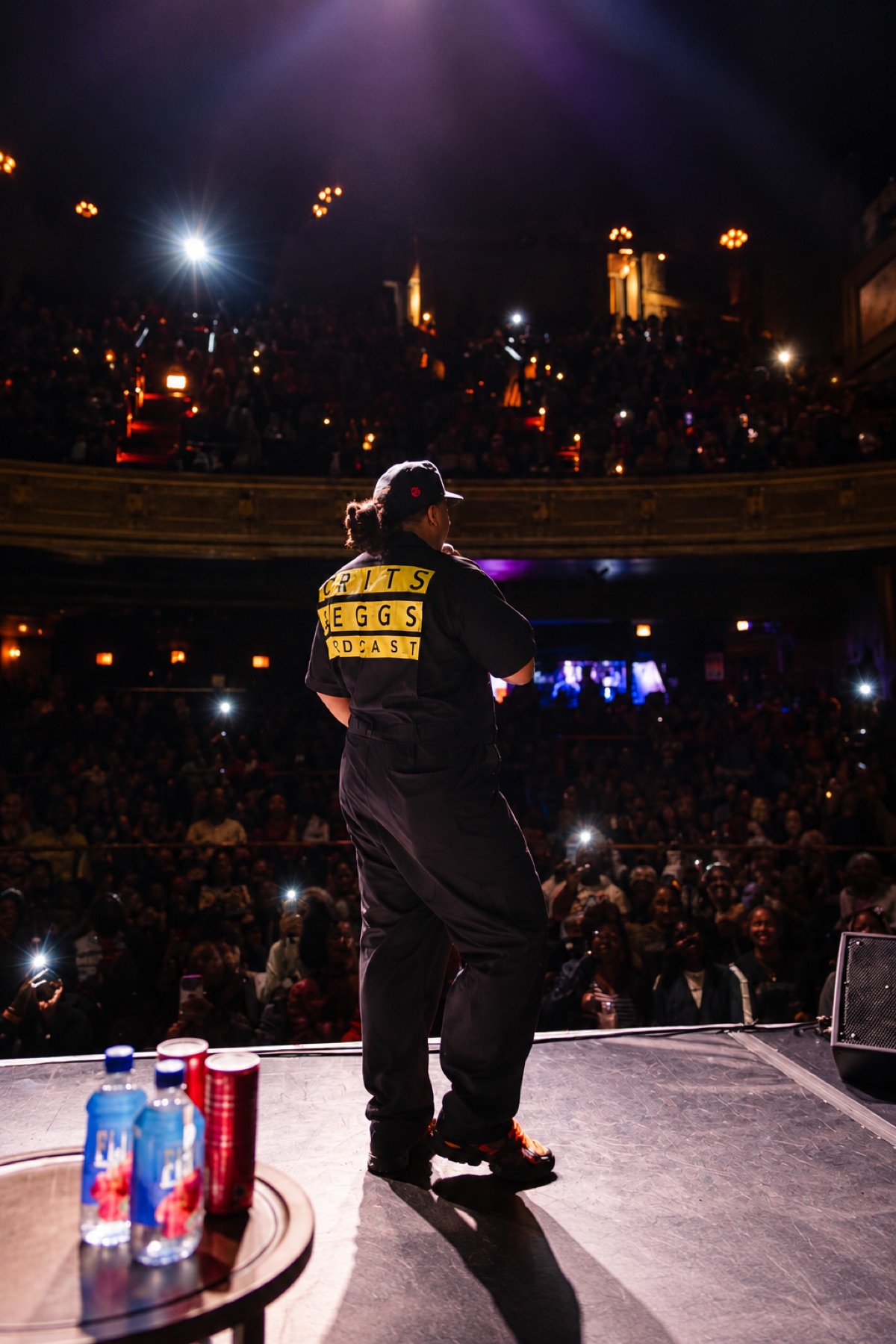
 CHICAGO, THE VIC · PHOTO: MIKAYLA / MPXVISUALS CHICAGO, THE VIC · PHOTO: MIKAYLA / MPXVISUALS
Deanté Kyle spent the pandemic in the most isolated job in America, talking into a phone in the cab of a truck nobody was listening to. Three years later he is on a twenty-three city national tour that runs into next year, booking two nights in New York, and the thing he is asking America to do is sit down at a table together.
Editor’s Note
This piece is built from the public record. Hip Hop Weekly has not sat down with Deanté Kyle, and nothing here is written as though we have. Every fact is sourced from his own on-air appearances, from reporting in the Birmingham Times, and from his own tour announcement. There are no quotes reconstructed from secondhand summaries.
When we get the conversation, we will run it. Until then, the record is more than enough, and the tour is moving now.
Think about what trucking actually is.
Two weeks. Sometimes three. Alone. You eat alone, you sleep in the vehicle, and the only voices you hear belong to people who are not in the room, because there is no room. It is one of the last jobs in the American economy that still requires a person to disappear.
Deanté Kyle was doing it through the pandemic, when freight was moving everything this country could not stop needing and the people moving it were the least visible workers in it.
And somewhere in there, he started recording.
Not in a studio. Not with a producer. In the truck. Grits and Eggs launched in March of 2023 out of the cab of a vehicle, which is a detail most people would file under humble beginnings and walk past.
Do not walk past it.
Because what he built in there was a conversation. A man with no audience, no booking agent, and nobody to talk to decided the answer to two weeks of silence was to start talking anyway, and to talk the way you would to somebody sitting next to you.
That is not a career strategy. Nobody drafts that on a whiteboard. That is what a person does when the alternative is going quiet.
He told The Breakfast Club in September that the trucking is not some distant chapter. Asked how long it had been, he put it at a year ago in April. The man filling rooms right now was behind the wheel more recently than most of his audience realizes.
Here is the part that tells you who he is.
He did not leave and then perform having left.
He still talks to truck drivers. He still watches diesel prices, because that number is not trivia to him, it is somebody’s month. On that same Breakfast Club appearance he mentioned friends calling him about selling their trucks, because the economics stopped working and the math no longer closes.
He still goes into schools to talk to kids.
There is a version of this story where a man gets out of a hard job and spends the rest of his life describing the hard job to people who have never done it. That version is everywhere. It is a whole genre.
This is not that. He kept the phone numbers.
He lives in Georgia now. Before that it was Gadsden, Alabama. The accent never got sanded down and the vocabulary never got upgraded for a national audience, and that turns out to have been the entire advantage.
What Deanté Kyle does on a microphone is harder than it sounds, and it is hard because it refuses the easiest move available.
The easiest move is to be clever at people.
There is an enormous market right now for the voice that never tells you what it actually thinks, only what you got wrong. That takes the other side on purpose and calls it independent thinking. That builds a career on being the only person in the room who sees clearly, which quietly requires everybody else in the room to be a mark. It performs intelligence instead of transmitting any.
Grits and Eggs does the opposite. He tells you what he thinks, in the words your uncle uses, about pop culture and politics and the economy and what is happening to Black men, and then he lets it sit there without dressing it up.
Twice a week. More than a hundred and sixty episodes.
Consider one line of his on the economy, speaking live on his Instagram: socialism for all, not just big corporations.
Eight words. No degree required to follow it, no jargon to decode, and it lands a critique of corporate welfare that takes most commentators a thousand words and a chart to get to. People who talk like that are usually accused of oversimplifying. What they are actually doing is declining to hide.
Plain language is not the absence of craft. Plain language is what is left after you take out everything you were doing to protect yourself.
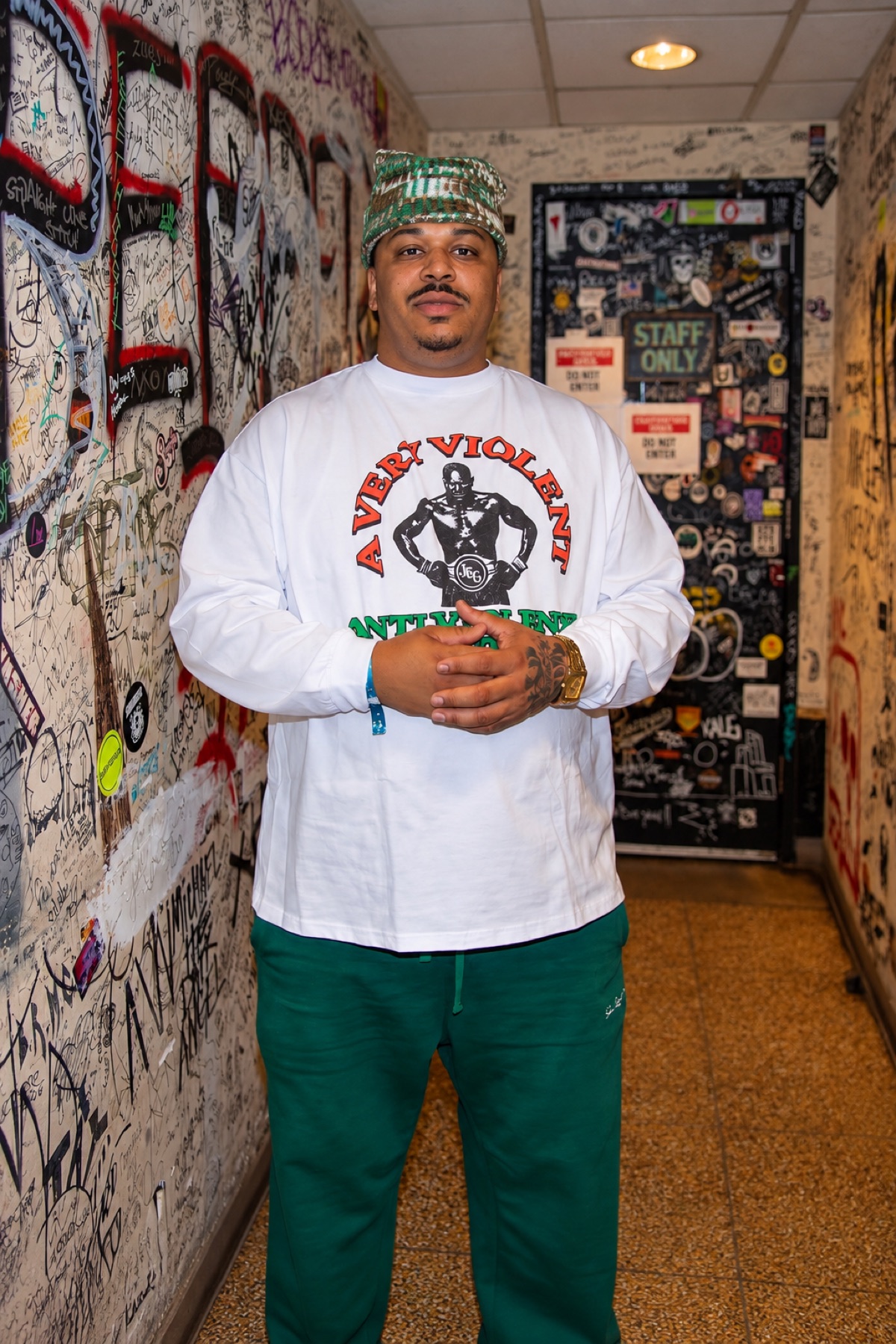
In April, Grits and Eggs played the Stardome in Birmingham, a comedy club that seats four hundred and twenty. It sold out, and the Birmingham Times reported the room left enlightened and reflective, which is not the standard review of a Wednesday night at a comedy club.
Six months later he opened this tour at The Vic in Chicago. The Vic holds fourteen hundred.
Four hundred and twenty in April. Fourteen hundred in October. That is the whole trajectory in two numbers, and there is no label, no network and no viral accident anywhere in it.
The Coming Thru America tour runs twenty-three dates across five months, opening in Chicago on October 1 of this year and closing in Atlanta in February of 2027. House of Blues in Cleveland the next night, Stage AE in Pittsburgh the night after that, Detroit the night after that. Four cities, four nights. Then Denver, San Francisco, Virginia Beach, Greensboro, Baltimore and Washington back to back.
And then this: New York City on January 9, 2027, and New York City again on January 10.
Anybody who has ever booked a room knows what a second night means. You do not add one out of optimism. You add one because the first one went.
Understand what these buildings are. They are music venues. People are buying tickets, arranging childcare, parking, and standing in line to watch two men have a conversation that is free on their phone.
Nobody buys a ticket to a take. You cannot sell a seat to a position. What people are buying is the room, and the chance to be in it with other people who were also listening alone.
Which is the same instinct that started in the truck, scaled up. He was by himself, so he made a conversation. Now his audience is by themselves, and he is making them a place to be.
Size of room is one measure. Here is a better one.
On September 19, Colin Kaepernick sat down at the Ray Charles Performing Arts Center at Morehouse College, in front of a full house, to talk about The Perilous Fight, the memoir Legacy Lit had published four days earlier. The night was presented by the National Association of Black Bookstores. Eleven cities on that tour, Black bookstores in all of them.
The chair across from Kaepernick had Deanté Kyle in it.
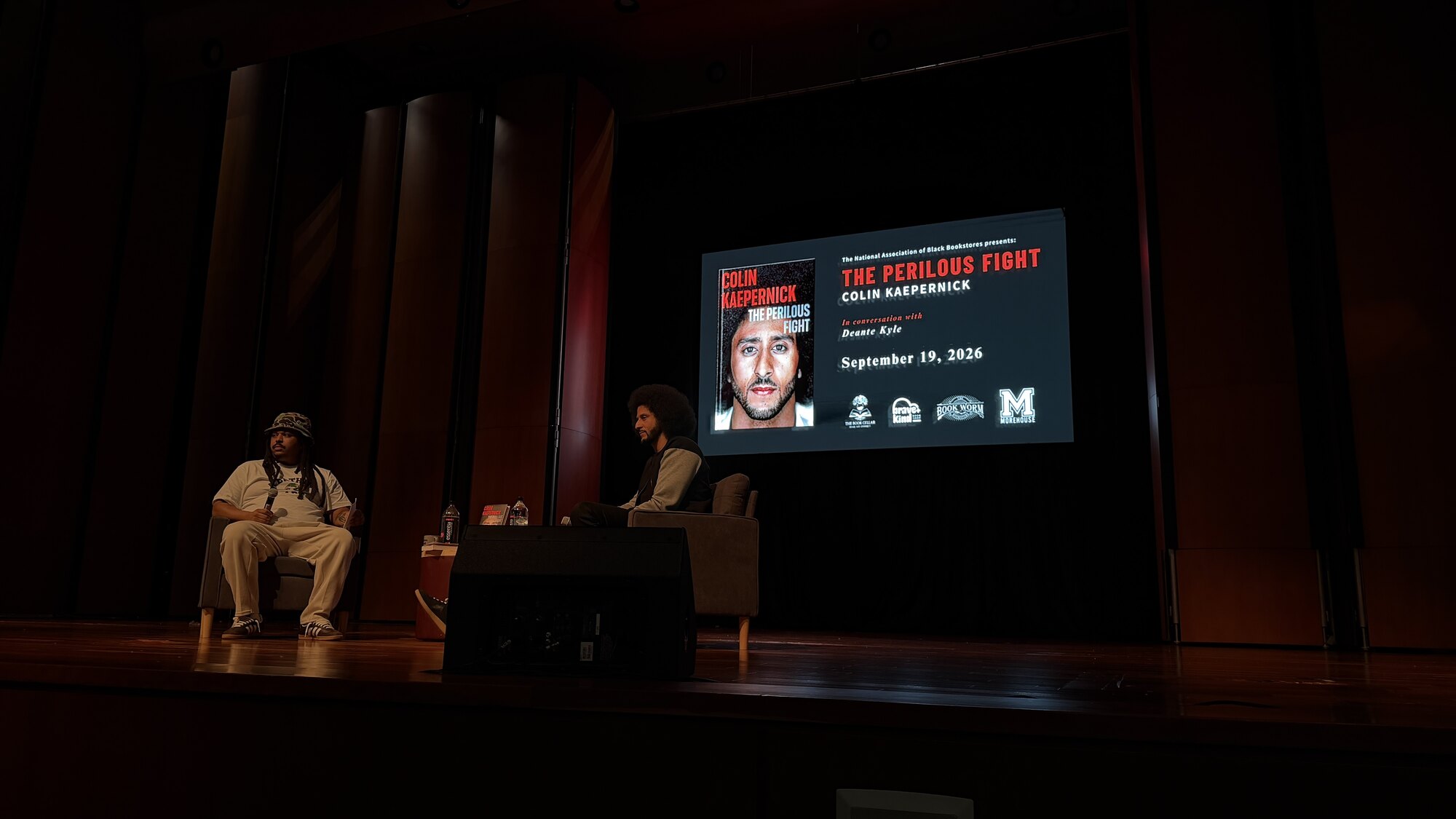
Hip Hop Weekly was at Morehouse that night to cover Kaepernick. We came away thinking about the other man on that stage.
Consider who else could have been in that chair. Kaepernick has not been generous with his time or his story for ten years. When he finally sat down to tell it, the man he told it to in Atlanta had been driving a truck the year before.
That is not a booking. That is a judgment about who can be trusted with something.
On October 1, Kyle called for something he is naming the Black Boycott.
The ask, as it has circulated: stop eating out for the month of October, with the exception of Black-owned restaurants. Use the Black Farmer’s Index to buy proteins and produce from Black-owned farms. Cook with it.
Then cook a Sunday dinner every week, and invite people over to eat it.
Read that last part again, because it is the part nobody designing a protest would think to include.
The ask is not only where the dollar goes. The ask is that you be in a room with other people, on purpose, every week, for a month. Fellowship and strategy, in person, at a table, over food somebody cooked.
A man who spent two and three weeks at a time with nobody to talk to is telling America the problem is that we are all alone and buying things.
Whatever that is, it is not a hot take. It costs the person saying it nothing and costs the person doing it a real Sunday. There is no engagement metric that rewards telling your audience to put the phone down and feed somebody.
There is a loud argument running right now about what a Black voice with reach is supposed to do with it.
Deanté Kyle is answering it without entering it.
He is not the most credentialed person in the conversation. No network backed him and he did not come up through one. What he has is three years, a hundred and sixty some episodes, a touring audience, and an origin that cannot be purchased, because the only way to get it is to have actually done the job.
He cannot be bought, because nothing about his position was bought. No network installed him. No algorithm anointed him. He talked into a phone in a truck until people showed up, and the people who showed up are now filling balconies.
A voice like that is rare, and the conditions that make one are getting rarer. Worth protecting while we have it. Worth being in the room for.
He is coming through. Go.
OCTOBER 2026
1 Chicago · 2 Cleveland · 3 Pittsburgh · 4 Detroit · 27 Denver · 29 San Francisco
NOVEMBER 2026
18 Virginia Beach · 19 Greensboro · 21 Baltimore · 22 Washington D.C.
DECEMBER 2026
17 Tempe · 19 Dallas · 20 Houston
JANUARY 2027
7 Bridgeport · 8 Boston · 9 New York City · 10 New York City · 20 Columbus · 21 Louisville · 23 Milwaukee
FEBRUARY 2027
3 Tampa · 5 Orlando · 13 Atlanta
Full routing and official tickets at deantekyle.com/tour
Buy there. Kyle has told audiences directly to go through his own site rather than resale, because fans get taxed on the secondary market and the tickets sometimes do not work. The ticketing runs through AXS, Ticketmaster and a handful of club box offices depending on the city, and his tour page routes you to the right one.